Call center automation solutions are transforming support teams from cost centers into powerful growth engines. By combining intelligent routing, AI assistance, and streamlined workflows, businesses can deliver faster, more consistent customer service while dramatically improving agent productivity and reducing operational costs. Improving customer support with contact center AI has become a key strategy for modern organizations, and understanding the role of AI in omnichannel customer support ensures businesses can engage customers seamlessly across every channel.
This guide breaks down what call center automation really is, how it works, and the practical steps you can take to implement it successfully in your organization.
Expanding the Benefits of Call Center Automation
Modern businesses are increasingly turning to advanced computing for AI-driven customer service to enhance efficiency and accuracy in handling queries. By leveraging these technologies, agents can focus on more complex tasks while routine inquiries are resolved automatically. This approach not only boosts satisfaction but also reduces wait times significantly.
Integrating high-performance computing solutions for support centers allows organizations to process large volumes of data quickly, helping predict customer needs and personalize interactions. With these tools, companies gain insights into patterns that inform better decision-making and proactive support.
Marketing teams can also benefit from strategies for enhancing customer communication. By aligning AI capabilities with targeted campaigns, businesses ensure that every customer touchpoint is consistent and effective. This integration bridges the gap between service and marketing, creating a unified experience that drives loyalty.
Another key aspect is understanding how AI enhances omnichannel engagement across multiple platforms. When implemented correctly, AI helps manage interactions across phone, chat, email, and social media, giving customers seamless support no matter the channel. This ensures agents are never overwhelmed and customers always feel heard.
Finally, leveraging top financial insights for optimizing call center operations helps organizations balance cost with performance. By analyzing ROI, resource allocation, and operational metrics, companies can make data-driven decisions that maximize the value of their automation investments.
Top 10 Call Center Automation Solutions for Modern Businesses
Choosing the right call center automation solution is crucial for improving efficiency, agent productivity, and customer satisfaction. Here are the top platforms to consider:
1. Bright Pattern – AI-Driven Contact Center Solutions
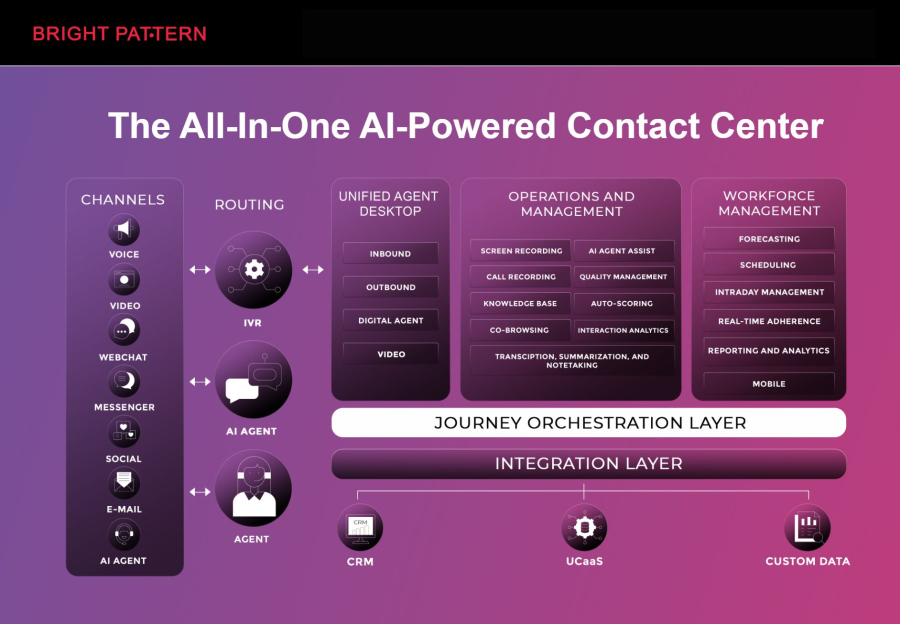
Bright Pattern stands out as a leading provider of call center automation solutions, offering a robust AI-driven platform designed for omnichannel support. Their solution streamlines workflows, enhances agent efficiency, and ensures customers receive consistent service across every channel.
Key features include:
- Intelligent call routing to the most suitable agent
- AI-assisted responses for faster resolution
- Omnichannel support including voice, chat, SMS, and social media
- Real-time analytics to monitor performance and optimize operations
- Seamless integration with CRM and business applications
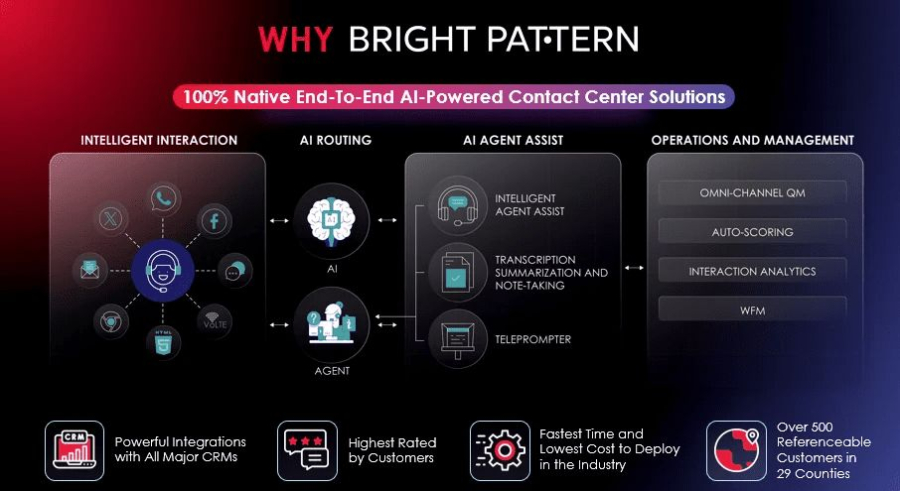
Bright Pattern’s focus on AI-powered automation helps organizations transform their support teams into proactive, growth-oriented centers, making it an ideal choice for businesses looking to modernize their customer service operations.
2. Five9 – Cloud Contact Center Platform
Five9 provides a cloud-based call center solution that emphasizes intelligent routing and automation. It helps agents handle more interactions efficiently while improving customer experience.
3. Genesys – Omnichannel Customer Experience
Genesys delivers a comprehensive platform for managing calls, chats, and emails, integrating AI tools to improve agent productivity and provide personalized support.
4. Talkdesk – AI-Powered Customer Service
Talkdesk combines cloud-based automation with AI insights to optimize workflows, reduce wait times, and support a variety of communication channels.
5. NICE inContact – Next-Gen Call Center Software
NICE inContact focuses on automating routine tasks and providing analytics-driven insights to improve contact center performance.
6. 8x8 Contact Center – Unified Communications
8x8 offers an integrated solution with AI tools for routing, monitoring, and reporting, helping teams deliver faster and more efficient support.
7. Avaya – Enterprise Contact Center Automation
Avaya provides enterprise-grade call center solutions with AI-assisted workflows, ensuring agents are supported in delivering seamless customer interactions.
8. RingCentral – Cloud Contact Center Solutions
RingCentral combines omnichannel communication with AI-driven automation to streamline operations and enhance customer satisfaction.
9. Zendesk – Customer Support Automation
Zendesk focuses on ticketing automation and AI-powered chatbots to reduce agent workload and speed up response times.
10. Salesforce Service Cloud – Intelligent Service Management
Salesforce Service Cloud integrates AI automation for call routing, customer insights, and omnichannel engagement, helping organizations improve resolution times and customer loyalty.
What Is Call Center Automation?
Call center automationrefers to technologies that handle repetitive, rules-based, or predictable tasks in the customer service process, so human agents can focus on higher value conversations and complex problem-solving.
It is not about replacing people. It is about enabling a smaller or same-sized team to handle more interactions, at higher quality, with less burnout and lower cost.
Common Types of Call Center Automation
- Interactive Voice Response (IVR)that guides callers through menu options, gathers basic information, and routes calls automatically.
- Automatic Call Distribution (ACD)that distributes calls to the best available agent based on skills, priority, or queue rules.
- AI chatbots and voicebotsthat resolve common questions without a human agent and hand off smoothly when needed.
- Robotic Process Automation (RPA)that executes back-office tasks such as data entry, form filling, or account updates.
- Agent assist toolsthat surface real-time suggestions, knowledge base articles, and next-best actions during live calls and chats.
- Automated outbound campaignsfor reminders, renewals, surveys, or notifications via voice, SMS, or email.
- Workforce management automationto forecast volume, schedule agents, and optimize coverage.
- Quality monitoring and analyticsthat automatically score interactions, detect trends, and highlight coaching opportunities.
Why Call Center Automation Matters Now
Customer expectations are rising, and traditional call center models are under pressure. Customers expect instant answers, short wait times, and consistent experiences across channels. At the same time, hiring and retaining skilled agents is getting more expensive.
Automation answers these challenges by helping you do more with less, without sacrificing quality.
Key Business Benefits
- Faster response timesthanks to self-service options and intelligent routing that minimize waiting.
- Higher first contact resolutionbecause agents get better context, guidance, and unified data.
- Lower operating costsby automating repetitive contacts and back-office work.
- Greater agent productivitythrough reduced manual data entry, fewer system hops, and real-time assistance.
- Improved customer satisfactionwith consistent, round-the-clock support and predictable outcomes.
- Scalabilityto handle peak periods or rapid growth without proportional headcount increases.
- Better decision-makingbased on rich analytics from every automated touchpoint.
Before and After Automation: What Changes?
| Area | Traditional Call Center | Automated Call Center |
| Call handling | Mostly manual; agents handle all steps end to end. | Machines handle routing, lookup, and simple tasks; agents focus on complex needs. |
| Wait times | Highly dependent on staffing and volume spikes. | Reduced through self-service and intelligent queue management. |
| Agent workload | Repetitive questions, high after-call work. | More value-added conversations; less manual wrap-up. |
| Consistency | Varies by agent experience and training. | Standardized flows, prompts, and knowledge suggestions. |
| Scalability | Requires significant new hiring to grow. | Automations scale easily with volume; targeted hiring. |
Core Components of Modern Call Center Automation
Modern call center automation is not a single tool. It is a coordinated stack of capabilities that work together across the customer journey.
1. Smarter IVR and Self-Service
Intelligent IVR and self-service portals are the front door of automated support. Instead of long, frustrating menu trees, modern systems use data and AI to understand caller intent and route accordingly.
- Intent-based menusthat listen for natural language, not just button presses.
- Authentication and verificationto identify the customer and pull relevant account details.
- Transaction handlingsuch as balance checks, order status, password resets, or simple changes.
- Smart handoffso when a human agent is needed, they receive full context of what the customer already did.
2. Intelligent Routing and ACD
Instead of routing calls simply to the next available agent, automated call distribution can route based on:
- Skillssuch as language, product expertise, or support tier.
- Customer profilesuch as value segment, account type, or history.
- Priority rulessuch as VIP queues, escalations, or service level commitments.
- Real-time conditionslike queue length, agent occupancy, and service level performance.
The result is fewer transfers, faster resolutions, and more efficient use of specialized skills.
3. AI Chatbots and Voicebots
AI-powered bots can handle a large portion of routine inquiries across channels such as web chat, messaging apps, and phone. When designed well, they offer immediate answers and can operate 24 / 7.
Effective bots typically excel at:
- Answering frequent questionslike opening hours, policies, and product details.
- Running guided flowsfor troubleshooting, onboarding, or ordering.
- Collecting informationsuch as contact details, issue descriptions, and screenshots before escalation.
- Handover to agentswith full conversation context to avoid repetition.
4. Agent Assist and Knowledge Automation
While bots take care of self-service,agent assisttools make your human agents faster and more accurate by:
- Surfacingrelevant knowledge articlesin real time based on what the customer is saying or typing.
- Providingautomated summariesof past interactions and account history.
- Suggestingnext-best actionsor offers according to rules and analytics.
- Auto-completingafter-call worklike call notes and disposition codes.
This reduces handle time, improves compliance, and helps new agents perform like experienced ones much faster.
5. Robotic Process Automation (RPA)
Many call center tasks involve updating multiple systems, copying data, or following strict procedures. RPA uses software robots to click through screens and perform these steps for your agents or in the background.
Examples include:
- Creating or updating customer records in several systems at once.
- Processing simple refunds or order changes following defined rules.
- Pulling reports and distributing them to stakeholders.
- Validating data and flagging exceptions for review.
By offloading this work to bots, you reduce errors and free agents to focus on conversation and problem solving.
6. Workforce Management and Scheduling Automation
Automation does not stop at customer-facing tasks. Modern workforce management tools use historical data and forecasting algorithms to:
- Predict contact volume by channel, day, and hour.
- Generate optimal agent schedules and shifts automatically.
- Balance skills and languages across queues and time zones.
- Monitor adherence and adjust staffing in real time.
This leads to better coverage, lower overtime, and fewer service level breaches.
7. Analytics, Quality Monitoring, and Reporting
Automated analytics tools can capture, transcribe, and analyze every interaction across channels. This allows you to:
- Identify the most common reasons for contact and target them for automation.
- Monitor compliance with scripts and regulatory requirements.
- Detect churn risk or upsell opportunities based on conversation signals.
- Automate quality scoring and flag calls for coaching.
With strong reporting in place, you can continuously refine your automation strategy for maximum impact.
How Call Center Automation Works in Practice
To understand the impact, walk through a typical customer journey in an automated environment.
Step-by-Step Example Journey
- Customer initiates contact.They call, start a web chat, or send a message.
- Intelligent intake.The IVR or chatbot greets the customer, identifies them, and collects the reason for contact.
- Automated resolution if possible.If the issue is routine, the bot or IVR completes the request using integrated systems.
- Smart routing if human help is needed.The system matches the customer to the best agent based on skills and priority, passing along full context.
- Agent assist runs in the background.As the conversation unfolds, the system suggests articles, steps, or offers to the agent.
- Back-office tasks are automated.RPA bots update systems, send confirmations, or open follow-up cases.
- Interaction is summarized and analyzed.Notes and disposition codes are generated automatically, and analytics tools capture insights for reporting and quality.
From the customer’s perspective, the experience is simple and fast. Behind the scenes, multiple automation layers are orchestrating a smooth, efficient process.
High-Impact Use Cases for Call Center Automation
Some use cases deliver particularly strong and quick returns. Focusing on these early can build momentum and demonstrate value.
1. Password Resets and Account Access
Password and login issues are among the most frequent and repetitive contacts. Automating this flow via IVR, chatbots, or self-service greatly reduces live call volume.
- Verify identity using multi-factor authentication.
- Guide the user through secure reset steps.
- Send confirmation via email or SMS automatically.
2. Order Status and Delivery Updates
Customers often contact support just to ask, "Where is my order?" Automation can answer this in seconds.
- Look up order status by phone number, email, or order ID.
- Provide real-time updates on shipping and delivery estimates.
- Offer automated options like changing delivery dates where allowed.
3. Billing and Payments
Billing queries are ideal for automation when backed by secure integrations.
- Provide balance information and due dates.
- Accept payments through secure automated flows.
- Handle common billing questions based on knowledge base content.
4. Appointment Scheduling and Reminders
For healthcare, professional services, and many local businesses, scheduling is a major workload driver. Automation can manage:
- Booking, rescheduling, and canceling appointments.
- Sending reminders via voice, SMS, or email.
- Collecting pre-appointment information through automated forms or bots.
5. Proactive Notifications
Instead of waiting for calls when something changes, proactive automation reaches out to customers before they feel the need to contact you.
- Service outage alerts and resolution updates.
- Shipping delays and new delivery estimates.
- Renewal reminders and subscription changes.
This reduces inbound volume and builds trust by keeping customers informed.
Planning Your Call Center Automation Strategy
A successful automation program starts with clear goals and a phased plan. You do not need to automate everything at once to see strong results.
1. Define Business Objectives
Start by clarifying what you want automation to achieve. Common objectives include:
- Reducing average handle time.
- Improving first contact resolution.
- Lowering cost per contact.
- Increasing self-service containment.
- Boosting customer satisfaction or loyalty scores.
Link each objective to measurable targets so you can track progress.
2. Map Customer Journeys and Contact Drivers
Analyze your existing interactions to understand why customers reach out, how often, and through which channels.
- Group contacts into categories, such as billing, orders, technical support, and account management.
- Identify the top 5 to 10 contact reasons by volume and effort.
- Evaluate which reasons are rules-based and repeatable versus complex or emotional.
This helps you find high-impact automation opportunities that are low risk and high value.
3. Prioritize Automation Use Cases
Score potential use cases based on:
- Volumeof contacts they represent.
- Complexityof the process and required integrations.
- Customer impacton satisfaction and effort.
- Time to valueand implementation cost.
Focus initial efforts on high-volume, low-complexity flows like order status, simple account changes, or password resets.
4. Align Stakeholders and Teams
Successful automation spans multiple teams:
- Operations leaderswho understand current workflows and performance.
- IT and integration teamswho connect systems and data.
- Compliance and legalto ensure privacy and regulatory alignment.
- Frontline agentswho provide feedback on what works in real conversations.
Involving these groups early streamlines implementation and accelerates adoption.
Best Practices for Implementing Call Center Automation
To get the most from automation, follow proven practices that protect the customer experience while unlocking efficiency gains.
1. Start Small, Then Scale
Launch automation with a focused pilot instead of attempting a full transformation all at once.
- Choose one or two high-impact workflows.
- Monitor customer feedback and metrics closely.
- Iterate and refine before rolling out more broadly.
This approach builds internal confidence and helps you learn quickly with limited risk.
2. Design with the Customer in Mind
Automation should make life easier for customers, not just for your operation.
- Use plain, friendly language in IVR prompts and chat flows.
- Minimize the number of steps required to complete a task.
- Always offer a clear path to a human agent when needed.
- Test flows with real users and adjust based on their experience.
3. Empower, Do Not Replace, Agents
Agents remain critical for complex, emotional, or sensitive interactions. Automation should empower them to do their best work.
- Use agent assist tools to remove friction from their day.
- Automate tedious after-call work and data entry.
- Provide training to help agents understand and trust new tools.
When agents feel supported, they become champions of your automation strategy.
4. Integrate Systems for a Single Source of Truth
Strong automation relies on accurate, timely data. Connecting your CRM, ticketing, billing, and communication platforms ensures:
- Automations have the data they need to act correctly.
- Agents see a complete view of the customer.
- Reporting provides a unified picture of performance.
5. Measure, Optimize, and Expand
Automation is not a set-and-forget project. Continuous optimization drives long-term success.
- Track key metrics such as containment rate, handle time, and satisfaction scores.
- Review conversation transcripts and flows regularly.
- Identify new automation opportunities based on emerging trends.
Small, ongoing improvements compound into significant performance gains over time.
Key Metrics to Track for Call Center Automation
To demonstrate the value of automation and guide future investments, monitor a mix of efficiency and experience metrics.
Efficiency Metrics
- Self-service containment rate(percentage of interactions resolved without an agent).
- Average handle time(AHT) for agent-assisted interactions.
- After-call work time(ACW) per interaction.
- Cost per contactacross channels.
- Agent occupancy and utilizationrates.
Customer Experience Metrics
- Customer satisfaction(CSAT) after automated and assisted interactions.
- Net Promoter Score(NPS) or loyalty indicators.
- First contact resolution(FCR) rates.
- Average speed of answer(ASA) and abandonment rates.
Agent Experience Metrics
- Agent satisfactionor engagement survey scores.
- Training time to proficiencyfor new hires.
- Turnover and attritionrates in service roles.
By linking these metrics to automation initiatives, you can clearly see where solutions are delivering the most value and where to focus next.
Building a Future-Ready Call Center
Automation is becoming a core capability of every modern call center. Organizations that embrace it thoughtfully are seeing:
- Sharper competitive differentiation based on effortless experiences.
- Higher margins driven by lower operating costs.
- More engaged agents who focus on work that truly matters.
- Data-driven decisions that continually refine service strategies.
You do not need to be a large enterprise to benefit. With the right approach, even small and midsize teams can deploy powerful automation quickly and cost-effectively.
Next Steps
If you are just starting your automation journey, a practical next step is to:
- List your top contact reasons by volume.
- Identify one or two workflows that are simple, repetitive, and rules-based.
- Design a streamlined, customer-friendly automated flow for each.
- Pilot the solution, measure results, and then expand to adjacent use cases.
By moving forward in focused, measurable steps, you will build a call center that is faster, smarter, and ready for the next wave of customer expectations.
Call center automation solutions are not just an efficiency play. They are a strategic investment in better customer relationships, stronger teams, and sustainable growth. The earlier you start optimizing with automation, the stronger your competitive position will become.
